
7 Essential Strategies for High-Performing Chronic Procrastinators

You’re not lazy; you are likely a high achiever stuck in a familiar, high-stakes loop. If you need strategies for high-performing chronic procrastinators, here is the uncomfortable truth: you don't need to eliminate the habit. Instead, you must learn to structure it into controlled, repeatable pressure that consistently drives output.
Most conventional advice fails you because it ignores the unique way you perform under stress. It is time to pivot: stop viewing your procrastination as a moral failing and start seeing it as an unmanaged advantage. Once you stop fighting your nature, you can redirect that last-minute energy into systems that make execution feel inevitable.
In this guide, you will learn to design constraints and environments that explore proven methods for overcoming procrastination as a high achiever. Each strategy is practical, tested, and built specifically for driven professionals who demand results over "busy work”.
Key Takeaways
- Engineered urgency & time-boxing: Use strict deadlines and fixed time limits to force action, because open-ended time leads to delay and overthinking.
- Minimum viable start: Start with the smallest step and accept functional output, because lowering entry effort breaks inertia fast.
- Separate planning from execution: Split thinking and doing, because mixing them slows you down with constant mental switching.
- Low-friction environment: Remove distractions and prep your workspace, because fewer barriers make starting almost automatic.
- Energy alignment: Match hard tasks to peak energy, because timing directly improves focus and output quality.
1. Engineer Productive Pressure (How to Stay Productive Under Pressure)
You don’t need to escape the pressure; you simply need to take control of it. Because high performers often subconsciously rely on urgency to trigger focus, you likely find yourself waiting for a deadline to feel productive finally. Instead of letting the clock dictate your output, you must learn to design intentional tension into your workflow for consistent execution.
Here is exactly how you can build that predictable system into your daily routine to stay ahead.
Build Deadlines That Trigger Action
Artificial deadlines only work when they feel genuinely real and unavoidable. Otherwise, your brain labels them as optional and delays action without hesitation. As a result, most self-imposed timelines fail to create real urgency or focus.
To fix this, you need a structured system that turns intention into enforceable action, as shown in the steps below:
- Set a deadline earlier than necessary
- Attach a visible consequence for missing it
- Share the deadline with someone else
- Use timers or countdown tools
- Track completion publicly if possible
Use Time Constraints to Eliminate Overthinking
When you have unlimited time, your brain slips into endless optimization mode instead of actual execution. This leads to overthinking choices and quietly delaying real progress without noticing it. In contrast, constraints create clarity by narrowing options and triggering immediate action.
With that in place, the list below will show you how to turn that pressure into execution:
- Assign strict time limits per task
- Work in focused, interruption-free blocks
- Stop when time expires
- Avoid extending sessions
- Review output briefly afterward
2. Start Before You’re Ready (Overcoming Procrastination for High Achievers)
Getting started is often your biggest bottleneck, even when the path ahead is clear. You likely delay because you’re chasing a polished, flawless opening, but that perfectionism only reinforces a cycle of inaction. To break free, you must lower your entry barrier and prioritize momentum over initial quality.
The following sections will show you exactly how to simplify your start and finally get moving.
Apply the Minimum Viable Start Rule
You don’t actually need motivation to get started, even though it feels like you do. What you really need is momentum that builds once you begin taking action. Starting small reduces resistance and makes it easier to move forward without overthinking.
Once that initial friction drops, this list will become easier to follow:
- Write one sentence
- Open the document
- Work for five minutes only
- Outline instead of executing
- Focus on a single micro-task
Remove Emotional Resistance to Starting
Delay often comes from emotional resistance, not the actual difficulty of the task. In many cases, your feelings about starting create more friction than the work itself. To move past this, you need to neutralize that internal resistance and reduce mental weight.
The breakdown below shows how different triggers can be adjusted to make starting easier:
| Trigger | Adjustment |
|---|---|
| Overwhelm | Break the task into micro-steps |
| Fear of failure | Focus on the draft, not the result |
| Unclear direction | Define next action only |
| Lack of urgency | Add time constraint |
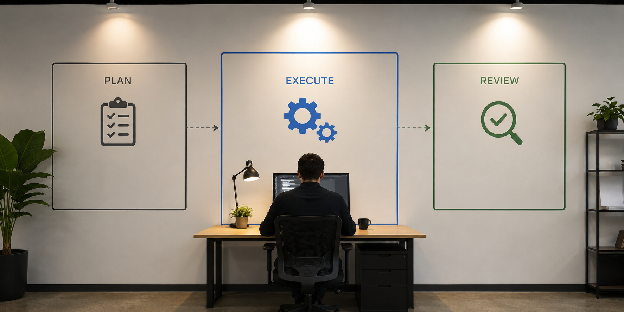
3. Separate Thinking from Execution (Productivity Strategies for Chronic Procrastinators)
Mixing planning and execution creates cognitive overload that stalls your momentum. When these modes bleed together, you end up overthinking instead of producing. The fix is simple: separate thinking from doing.
Here is how to decouple these phases to build a leaner, faster workflow
Create Clear Work Phases
When each phase has a clear, defined purpose, your brain stops wasting energy switching between contexts. This leads to smoother focus and fewer mental interruptions, which naturally improves execution speed.
From here, the breakdown below shows how to separate your workflow into distinct phases:
- Plan the structure and approach
- Define expected output
- Execute without revising
- Avoid introducing new ideas mid-task
- Move to review only after finishing
Eliminate Mid-Task Decision-Making
Every decision during execution creates hidden friction that slows your progress down. Constant on-the-spot choices interrupt focus and weaken momentum throughout the task.
That is why pre-deciding removes that mental load and clears the path for smoother execution, as shown in the points below.
- Decide on the tools before starting
- Prepare resources in advance
- Set clear task boundaries
- Avoid switching tasks mid-session
- Stick to predefined actions
4. Time-Box Everything (Time Management Tips for Driven Professionals)
Open-ended tasks often lead you into a spiral of delays because you lack a clear stopping point. Instead of executing, you likely find yourself overthinking and drifting through your workday without a sense of urgency. Time-boxing eliminates this friction by forcing you to take action within strict limits, effectively killing the cycle of endless refinement.
To get started, you simply need to break your day into fixed task limits and focused work sprints that you can apply immediately.
Assign Fixed Time Limits to Tasks
Deadlines push you into immediate urgency that forces action. In contrast, time-boxing helps you build steady consistency that improves your long-term output.
Together, they give you a balanced execution rhythm that reduces delay and burnout, as shown in the list below:
- Set a timer before starting
- Choose realistic but tight durations
- Work without interruption
- Stop when the time ends
- Move to the next task immediately
Use Short Work Sprints to Sustain Focus
Long sessions often push you toward mental fatigue and subtle avoidance behaviors that reduce output quality. Meanwhile, short bursts help you maintain high focus and sustained mental intensity throughout execution. Consequently, you get stronger output without losing momentum or burning out mid-task.
The steps below show how you can structure these focused work sprints effectively:
- Work in 25 to 45-minute blocks
- Take short breaks between sessions
- Reset focus before restarting
- Track completed sprints
- Adjust duration based on performance
5. Redefine “Done” (Why Successful People Procrastinate)
Your drive for perfection is likely the hidden engine behind why you continue to procrastinate on your biggest goals. Because your standards are often impossibly high, you find yourself delaying tasks to avoid the sting of falling short. This self-imposed pressure creates a mental bottleneck that stifles your momentum and prevents consistent execution.
To break the cycle, you must adopt a new definition of completion that prioritizes progress over an unattainable ideal.
Shift from Perfect to Functional Output
Perfection often slows you down because you chase unnecessary refinements instead of real progress. On the other hand, functionality pushes you forward by prioritizing usable output over flawless execution. Over time, this shift helps you build momentum without getting stuck in endless revisions.
The comparison below shows how you can rethink your definition of “done”:
| Old Mindset | New Mindset |
|---|---|
| Must be perfect | Must be usable |
| Final output | First draft |
| No mistakes | Fix later |
| Complete clarity | Enough to proceed |
Normalize Iteration as Part of the Process
You don’t need perfect execution on the first attempt to make real progress. What matters more is your ability to build consistent improvement over time through iteration. Each attempt teaches you something that sharpens your next move and strengthens your output.
The list below shows how you can turn early drafts into continuous improvement:
- Expect multiple revisions
- Focus on speed in early drafts
- Separate creation from editing
- Improve in cycles
- Track progress, not perfection

6. Design a Low-Friction Environment
Your environment shapes your behavior far more effectively than sheer motivation ever will. If you find that starting feels difficult, your current setup is likely working against your execution process. To fix this, you must proactively remove friction before you even begin your deep work session.
Once you master that principle, you can focus on building a low-friction workspace that eliminates distractions with minimal effort.
Eliminate Common Distractions
Distractions disrupt your focus and make it harder to regain momentum once you’ve lost it. Gradually, they increase mental friction, slowing your ability to re-enter deep work and maintain consistency.
Protecting your attention becomes essential, and the list below shows how you can minimize distractions and sustain execution flow:
- Turn off notifications
- Close unnecessary tabs
- Silence non-essential apps
- Use website blockers if needed
- Keep your workspace clean
Prepare Your Workspace for Immediate Action
Preparation reduces your startup effort by eliminating unnecessary friction before you even begin working. Naturally, the easier the setup feels, the more likely you are to shift into action without delay or hesitation.
Therefore, organizing your workspace in advance sets the stage for effortless execution, as shown in the steps below:
- Open required tools beforehand
- Organize files and resources
- Define the first task clearly
- Keep essentials within reach
- Use the same workspace consistently
7. Align Tasks with Energy Peaks
Not all hours are equal, and your output depends on timing, not just effort. Your productivity improves when you align work with your natural energy cycles instead of forcing consistency. This is a core part of time management tips for driven professionals who want sustainable performance.
Therefore, understanding your peak and low-energy windows becomes essential before you decide what to work on next.
Identify Your Peak Performance Windows
You already experience natural high-focus periods that surface throughout your day without conscious effort. The real advantage comes from learning to recognize those windows and deliberately channeling them into demanding work.
Explore the list below on how you can pinpoint and leverage your peak performance moments with precision:
- Track energy for several days
- Identify consistent peak times
- Schedule deep work in those windows
- Avoid meetings during peak hours
- Protect these periods strictly
Match Task Difficulty to Energy Levels
Doing the wrong task at the wrong time reduces your performance and quietly increases delay. Your output suffers because your energy and task difficulty are misaligned throughout the day.
The table below shows how matching task types to energy levels improves your results and execution speed:
| Energy Level | Best Task Type |
|---|---|
| High | Deep, complex work |
| Medium | Collaboration |
| Low | Admin tasks |
Summary Table: Strategies for High-Performing Chronic Procrastinators
| Strategy | Core Benefit | Key Action |
|---|---|---|
| Productive Pressure | Controlled urgency | Set earlier deadlines |
| Minimum Viable Start | Reduced resistance | Start with small actions |
| Separate Thinking & Execution | Clear focus | Isolate work phases |
| Time-Boxing | Faster output | Limit work time |
| Low-Resistance Environment | Easier task initiation | Remove friction |
| Redefining Done | Less perfectionism | Focus on usable output |
| Energy Alignment | Higher efficiency | Work during peak hours |
Conclusion
The most effective strategies for high-performing chronic procrastinators lead you to consistent execution instead of reactive bursts of effort. You stop relying on pressure spikes and start producing work with steady control and clarity.
Your thinking shifts from fighting procrastination to designing conditions where action becomes the default. That change removes the cycle of delay, guilt, and last-minute execution.
Choose one strategy and apply it to your very next task today. Let execution, not planning, set the tone for everything that follows.
FAQs
Why do high achievers procrastinate more than others?
High achievers often deal with complex tasks, high expectations, and perfectionism, which increases the likelihood of delayed action.
Can procrastination actually be beneficial?
Yes, when structured properly, it can create pressure that enhances focus and performance.
What is the fastest way to overcome procrastination?
Start with a small action. The “minimum viable start” method is one of the quickest ways to break inertia.
How do I stay productive under tight deadlines?
Use time-boxing, eliminate distractions, and focus only on essential outputs.
Is procrastination linked to perfectionism?
Yes, perfectionism is one of the leading causes of procrastination, especially among high performers.
How can I improve time management as a driven professional?
Focus on outcomes instead of tasks, align work with energy levels, and avoid overloading your schedule.
What tools help chronic procrastinators the most?
Task managers, timers, and automation tools help reduce friction and improve consistency.